
ISO 9001:2015, BSCI and REACH: What the Certificates Cover
Three documents turn up in almost every jewelry sourcing conversation: ISO 9001:2015 for the quality system, a BSCI audit for labour conditions, and REACH for restricted substances — here lead, cadmium and nickel. Each answers a different question. None of them tells you whether a factory can hold a 25–30 day sampling window.

Key takeaways
- ISO 9001:2015 covers a documented quality system across production stages, not the quality of individual pieces.
- A BSCI audit speaks to labour practices, working conditions and supply chain ethics — the questions retail compliance teams ask.
- REACH compliance is a materials statement about lead, cadmium and nickel; the plating finishes are stated as compliant with REACH and CA Prop 65.
- Sampling still runs 25–30 days and production 3–4 weeks, whichever certificates are on file.
What ISO 9001:2015 actually certifies
ISO 9001:2015 is a quality management standard. A factory that holds it has written down how work moves through its stages and has been audited on whether the floor follows that documentation. For a buyer, the practical value is the process list itself: concept and CAD design and prototype and mould work first, then cutting the sprue, polishing and textured surface art, followed by electroplating, final QC inspection and delivery, in that order.
The reason that matters is traceability. A shop with a documented sequence can say which stage produced a defect. A shop without one sends a replacement piece and hopes the fault was the fault. What the standard does not cover is price, capacity, or the finish on any single ring.
What a BSCI audit covers, and who asks for it
BSCI is a social compliance audit. It looks at safe working conditions, fair labour practices and ethical sourcing across the supply chain, and it exists because retailers and marketplaces screen suppliers on those points before listing them. The audit is not about metal at all, which is exactly why a jewelry buyer should keep the two questions apart.
When someone asks for your supplier's social documentation, the audit report is what they mean, and its age matters as much as its content. A report from several years back answers a different question from one covering the current operation.
The three metals REACH restricts
REACH compliance as published here is a statement that the materials are free from lead, cadmium and nickel. Nickel is the one that decides whether a piece can be sold into markets that regulate metal in prolonged skin contact, and lead and cadmium matter most on plated articles where a base metal sits close to the surface.
gold in 14K, 18K and 24K and or rhodium lead the list, with silver and brass sealed with anti-tarnish e-coating and vacuum PVD plating on stainless steel.
| Document | Scope as published | What to ask for |
|---|---|---|
| ISO 9001:2015 | Quality control system applied across all production stages | The scope statement and the current audit date |
| BSCI audit | Labour practices, working conditions, ethical supply chain | The reporting period and who audited |
| REACH compliance | Materials free from lead, cadmium and nickel | The restriction list behind the statement |
| Plating compliance | Finishes compliant with REACH and CA Prop 65 | Which base materials and finishes are in scope |
Why paperwork does not shorten a window
A documented factory still needs 25–30 days for a master sample, because that window is bench time: the 3D wax print, mould casting, then stone-setting, gloss polishing and custom plating. Mass production after approval runs 3–4 weeks. Certification changes the odds that a batch is repeatable, not the physics of casting a ring.
The honest reading is that certificates and lead times measure different things, and a supplier who quotes a shorter sampling window because of a quality certificate has confused the two. TTT Jewelry reports both sets of numbers separately, and a custom jewelry manufacturer worth keeping on a shortlist will do the same.
Worked example: the sampling window in weeks
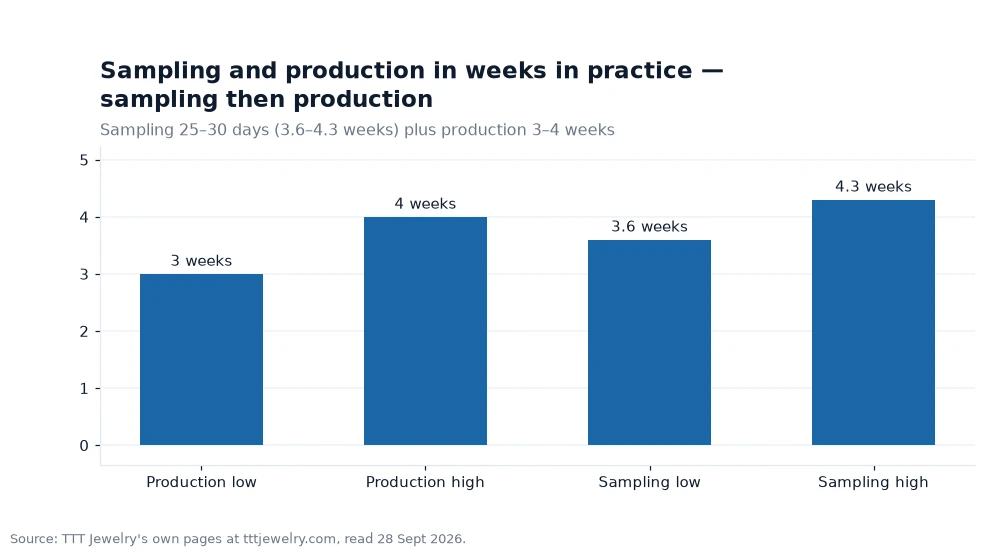
Convert the sampling figures to the unit production is quoted in. Twenty-five days divided by seven is 3.57 weeks, which rounds to 3.6. Thirty days divided by seven is 4.29, which rounds to 4.3. Production is quoted at a flat 3 to 4 weeks.
Laid out that way, sampling at 3.6–4.3 weeks sits just above production at 3–4 weeks, with only about a five-day spread between the tops of the two windows. Five days is the difference a single rejected sample costs, so the sample gate is not a rounding detail to be planned around; it is the gate that moves a launch date.
How to verify the three documents without a visit
Ask for the documents in one message rather than three. The quality certificate should come with its scope, the social audit with its period, and the materials statement with the restriction list. If the reply is a logo wall with no dates, the compliance claim is decoration.
Then check the claims against something the supplier says about its own process. A factory that publishes its eight steps, its minimums and its plating routes has already told you how it thinks about detail; the certificates are worth reading in that light rather than instead of it.
Three questions that make a certificate useful
A certificate becomes useful the moment it is attached to something specific. Ask which production stages the quality system covers and get a list back, from concept design through to delivery, and the document stops being a badge. Ask what period the social audit covered, and you learn whether it describes the operation you are buying from or one that existed before it.
For the materials statement, ask which base materials are in scope. Silver, brass and stainless steel each have their own supply chain and their own plating route, so a blanket line about compliance is less informative than one that says where it applies and where it does not.
Where the restricted metals matter most
Lead and cadmium matter most on plated articles, because the coating is what a customer's skin meets and a base metal sits directly underneath it. That is the argument for treating plating as a compliance decision rather than a cosmetic one: a piece can pass a visual check at the bench and still be the wrong chemistry for the market it is sold into.
Nickel matters most on pieces designed to be worn continuously, such as ear wires, rings and bracelets. That is why the base material is worth fixing before the CAD stage — switching it later changes the plating route, the minimum order and the hallmark together.
Frequently asked questions
Does ISO 9001:2015 certify the jewelry itself?
No. The standard covers the factory's quality management system and the documentation around its production stages; the inspection record that ships with your order is what describes the pieces.
What does a BSCI audit tell a jewelry buyer?
It addresses labour practices, working conditions and supply chain ethics. It says nothing about materials or finishes, which is why retail compliance questions and REACH questions are asked separately.
Which substances does REACH compliance exclude?
Lead, cadmium and nickel, as published by the factory, with the plating finishes stated as compliant with REACH and CA Prop 65 standards as well.
Building a compliance question into the first email
Put the three documents in the same message as your design brief. That way the reply tells you whether compliance and production sit in one place or get passed between a sales office and a factory. The OEM/ODM pages show how the two routes are separated on the supplier side, and the answers page covers the same ground in shorter form if you need to forward something to a colleague.
The specification quoted throughout — the eight-stage factory route / the five packaging components, the 14K / 18K / 24K gold and rhodium plating list — is recorded at the supplier's own site at tttjewelry.com itself, which I read on 28 Sept 2026. The day-and-week bookkeeping is mine alone[1].