
Lead-Time Red Flags in a Vegan Fragrance Order
Red flags in a fragrance order are rarely dramatic. They are small asymmetries in how a supplier talks about time: a schedule with no documentation stage, a revision allowance described as unlimited, a substitution described as trivial. Each one predicts a specific kind of slip, and each one can be tested with a follow-up question rather than an accusation. Brands that catch these signals early usually keep the relationship and fix the plan; brands that ignore them find out during printing, when it is expensive.
Key takeaways
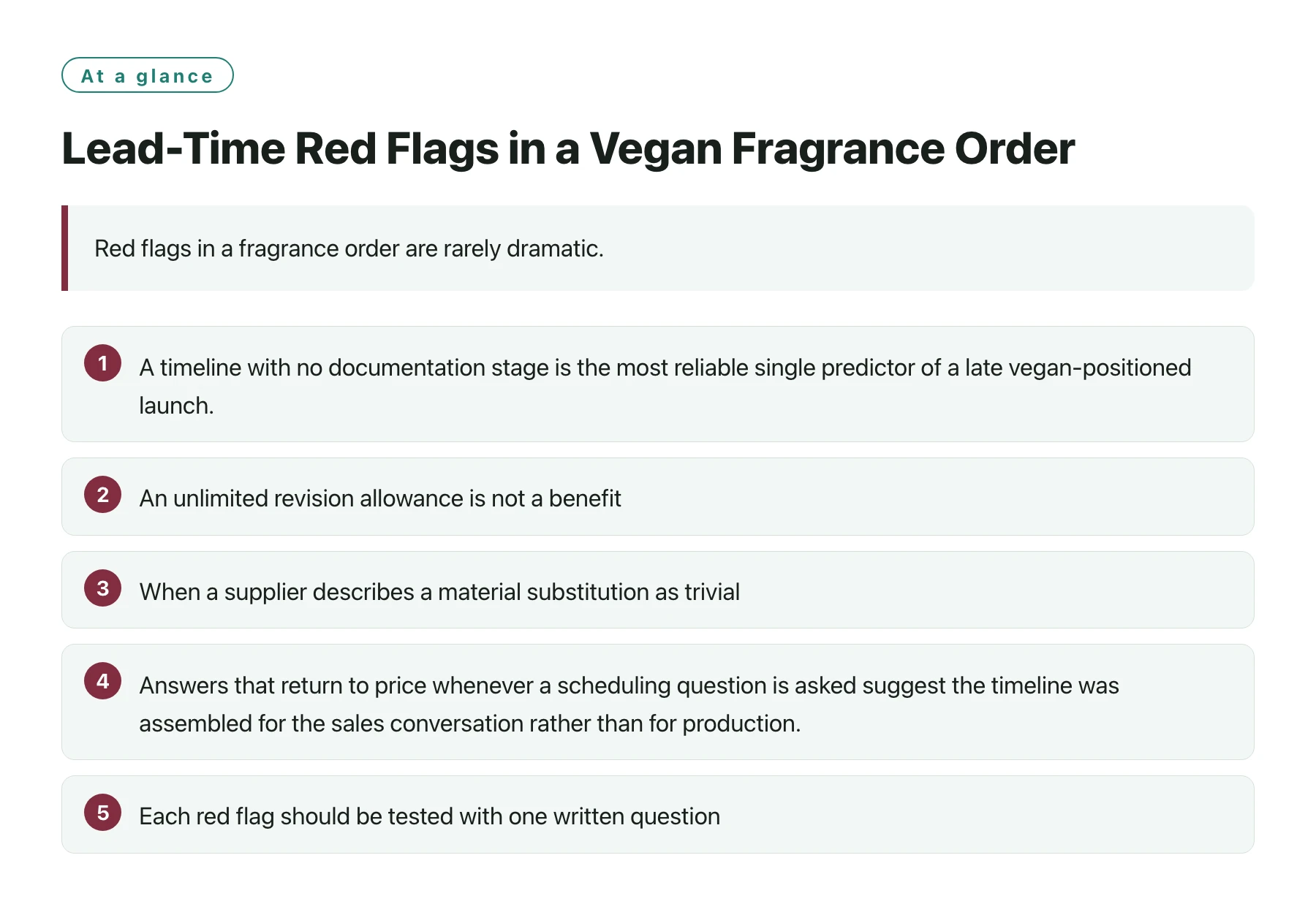
- A timeline with no documentation stage is the most reliable single predictor of a late vegan-positioned launch.
- An unlimited revision allowance is not a benefit; it usually means no revision round has been scoped or priced, so the second round becomes a negotiation.
- When a supplier describes a material substitution as trivial, the tariff is usually that no re-check against safe-use limits was planned.
- Answers that return to price whenever a scheduling question is asked suggest the timeline was assembled for the sales conversation rather than for production.
- Each red flag should be tested with one written question, because written answers are what the project will be managed against later.
Founders who have been through one disappointing launch tend to develop an instinct for the moment a conversation stops being about the product and starts being about reassurance. That instinct is worth formalising, because the signals are consistent. They are not lies; they are omissions that arise when a supplier describes the work it enjoys rather than the work that gates the calendar.
On a vegan-positioned order, the omissions concentrate in one area: documentation. Most suppliers are comfortable discussing scent, bottles and production, and considerably less comfortable discussing material statements, label review and change control, because those activities involve parties outside their building. A timeline that glosses over them is not dishonest, but it is incomplete in the place that matters most to you.
The six signals below are written as things you will hear or read, followed by what each one predicts. None of them requires you to end a conversation. All of them require a second question.
Signals that appear in the document
The written proposal is the best place to look, because it is where the supplier has committed to something. Read it for what is absent as carefully as for what is present, and note how many of the stages it names actually depend on your decisions rather than on the factory's equipment.
A useful habit is to mark every stage that involves a document or an approval, then count them. A proposal for a positioned product that contains two such stages is describing a simpler project than the one you are buying.
The timeline has no documentation stage
This is the strongest single signal. Documentation for a vegan claim does not happen automatically at the end; it has to be collected from material suppliers and reconciled with the label before printing. If the proposal moves from sample approval straight to production and printing, the documentation has either been assumed or ignored, and either way it will land on the critical path later.
The test is a single question: at what point are material statements and allergen information collected? A good answer names a stage and a responsible party. A weak answer promises that it will be handled.
The revision allowance is described as unlimited
Unlimited revisions sound generous and usually mean the opposite. A defined allowance tells you how many rounds were considered when the schedule was built and what a further round costs. An open-ended promise tells you neither, and the second round is where scope disputes begin.
Ask for the number of rounds included, the expected duration of each, and the price of the round after that. A supplier that answers precisely is easier to work with than one that answers warmly.
Sampling is priced, but evaluation time is not scheduled
Many proposals include the sample and omit the window for evaluating it. That window is real: a scent has to be worn, compared over hours, and discussed by whoever has approval authority. Because the omission is on your side of the table, it is easy to accept, and it is also the most common source of a ten-day slip that gets blamed on the factory.
Signals that appear in the answers
Conversations reveal what documents hide. The useful thing to listen for is not hesitation but redirection: a scheduling question answered with a price, a quality question answered with a certificate, a compliance question answered with a market success story.
Redirection is not necessarily evasion. Sales teams are trained to talk about what buyers usually ask about, and buyers usually ask about price. The signal only becomes meaningful when it repeats across several questions.
Every scheduling question returns to price
If two or three attempts to discuss stages produce answers about cost, the timeline was probably assembled for the proposal rather than from the production plan. That does not make the price wrong, but it means the schedule should be treated as marketing until it is written down stage by stage.
Nobody can name who signs the batch release
The release signature is the point at which responsibility transfers, and a supplier that cannot name the role is unlikely to have a documented release step. Independent testing services exist for cosmetics and personal care precisely because a buyer may want a measurement that does not depend on that internal signature [1], and their use is a reasonable fallback when the internal process is unclear.
A substitution is described as trivial
On a vegan-positioned order, substitution is the central technical event rather than an aside. Replacing a material means checking the replacement against safe-use limits, updating the material statements, and often adjusting the formula's balance. Fragrance materials are governed by standards maintained by the International Fragrance Association that set restrictions and usage limits, and those standards are the reason a swap is a project step rather than a note [2].
The related omission is labelling. Removing or adding a material can change what has to appear on the label, and the European Commission's pages on specific cosmetic product topics, which include allergens among other areas, are a practical indication of how specific those questions become per market [3]. A supplier that treats a swap as trivial usually has not looked at either question.
What to do when you see one or two
Test rather than withdraw. Send one written question that would be cheap for a well-run supplier to answer and expensive for a poorly run one to fake: the stage at which material statements are collected, the name of the role that signs the release, the price of a third revision round. Keep the answers in the project file, because they become the reference when the schedule is discussed later.
If several signals appear together, the practical conclusion is that you will be managing the schedule yourself. That is manageable if the factory is technically strong and the price is right, but the work should be planned for rather than discovered. A brand that runs its own documentation index and its own label review checklist can absorb a partner with weak project management; a brand that cannot will inherit the delay.
It is also worth knowing what a healthy answer looks like before you compare. Written material on how a private label partner should be assessed, such as a guide to what a good private label perfume factory looks like, gives a baseline for judging the proposals you receive, and industry bodies such as Cosmetics Europe publish material that helps a buyer understand who the counterparties in the sector are [4].
None of this requires a difficult conversation. A brand that arrives with three precise questions, and writes down the answers, is treated differently from a brand that arrives with a budget and a hope.
Settle the model before you judge the answers
The red flags above apply differently depending on what you are buying. Under an ODM arrangement, more of the development risk sits with the supplier, which changes where the documentation questions land. an ODM partner for fragrance brands is a different structure from a pure manufacturing contract, and the route should be settled before the shortlist is drawn, because the same weak answer can be harmless in one model and serious in the other.
Where to see a process described
It is useful to see how a manufacturer describes its own process before you judge anyone else's. Xuelei fragrance brand sets out the development and production route in the order it happens, which gives you a baseline for the timelines you are being shown.
A supplier that is comfortable with that level of scrutiny will make it easy to see, which is the only thing you are really trying to establish. A supplier that answers with positioning rather than stages has told you what the next few months will feel like.
Write down every scheduling answer you receive during shortlisting. Six weeks later, when a date is under pressure, the written answer is the difference between a negotiation and an argument.
Sources
- SGS: Cosmetics, Personal Care & Household Testing —— Testing, inspection and certification services for cosmetics and personal care, including microbiological, stability and safety testing aligned with cosmetics GMP.
- IFRA Standards Library (International Fragrance Association) —— The IFRA Standards Library lists the restrictions the fragrance industry applies to individual fragrance ingredients, based on safety assessments; it is the reference point for compliant fragrance formulation.
- European Commission: Cosmetic Products — Specific Topics —— EU pages covering specific cosmetics topics such as product claims, nanomaterials and animal-testing rules.
- Cosmetics Europe —— The European trade association for the cosmetics and personal care industry, publishing guidance, positions and market information.
Frequently asked questions
What are the warning signs when choosing a fragrance supplier?
A timeline with no documentation stage, an unlimited revision allowance with no scoped rounds, no scheduled evaluation window, price-only answers to scheduling questions, no named release authority, and substitutions described as trivial.
Why is a missing documentation stage such a strong signal?
Because material statements and label review gate printing on a positioned product. If they are not in the plan, they will appear on the critical path after approval, which is when there is no slack left.
Should I walk away from a supplier with red flags?
Not automatically. A technically strong factory with weak project management can work if you manage documentation and label review yourself. The decision depends on whether you have capacity to do that.
How do I test a supplier without sounding hostile?
Ask one narrow, factual question whose answer is a stage, a role or a price. Well-run suppliers answer quickly; the answer itself is the test, and no accusation is required.
Do these signals differ between OEM and ODM?
Yes. Under ODM more development risk sits with the supplier, so documentation questions land differently. Settle the model first, then judge the answers against it.
S'abonner à la veille — 7 jours offerts
Le Brief Chine, les rapports sectoriels et l'accès complet aux 18 400+ fiches entreprises. Sans engagement.